
Boat Dock Builder for Lake Travis
Longhorn Docks designs, builds and repairs boat docks across Lake Travis, from Hudson Bend and Lakeway to Spicewood and Briarcliff. Docks here are floating by default, anchored for a lake that has moved more than 90 feet between its record low and record high, and built to LCRA’s dock safety standards. Custom aluminum docks run $15,000 for a single slip to $150,000 for a multi-slip covered dock. Call (512) 200-4244 for a free site walk.
Why Lake Travis Docks Are Built Differently
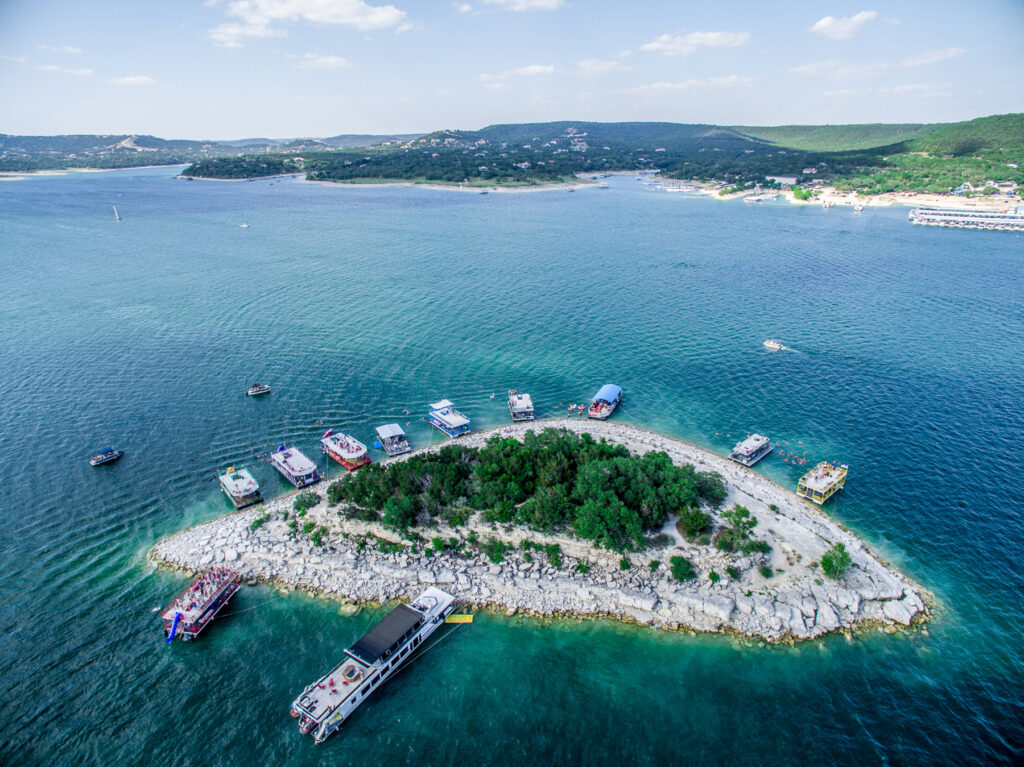
Lake Travis is a flood-control reservoir, not a constant-level lake. Full pool is 681 feet above sea level. LCRA’s record low is 614 feet in the 1951 drought and the record high is 710 feet in the 1991 flood. In the 2011 and 2023 droughts the lake fell more than 45 feet below full, and in October 2018 it crested above 700 feet. On October 4, 2026 it sat at 677.8 feet, 94.4 percent full, according to Water Data for Texas.
A dock that works on Lake Austin can fail on Lake Travis. Fixed docks end up high and dry in a drought or underwater in a flood. Short anchor cables snap when the lake rises. Floats rated for calm water break up in the wake traffic off Hudson Bend on a summer weekend.
Longhorn builds for the lake as it behaves, not as it looks on the day of the site walk. We measure water depth at full pool and at the low-water mark, size anchor cables and winches for the full range, and set gangway lengths so the dock stays usable when the shoreline moves 100 feet.
What Kind of Dock Works on Lake Travis?
Floating Docks: The Default
Almost every dock we build on Lake Travis floats. The dock rides up and down with the lake, so your boat sits at the same height whether the water is at 640 feet or 681. Aluminum frames and encapsulated floats, with an articulating gangway to shore.
Fixed Docks: Only in Deep Coves
A fixed piling dock only makes sense where the water stays deep at the low-water mark, which rules out most of the lake. Where it fits, we set pilings into the limestone and build the deck high enough to clear a flood crest.
Anchoring for a Moving Lake
Cable and winch anchoring sized for the full range of the lake, with shore anchors set into rock, not soil. We check cable length against the record high and the drought low, because a cable that is right at 677 feet is wrong at 640.
Lifts, Roofs and PWC Ports
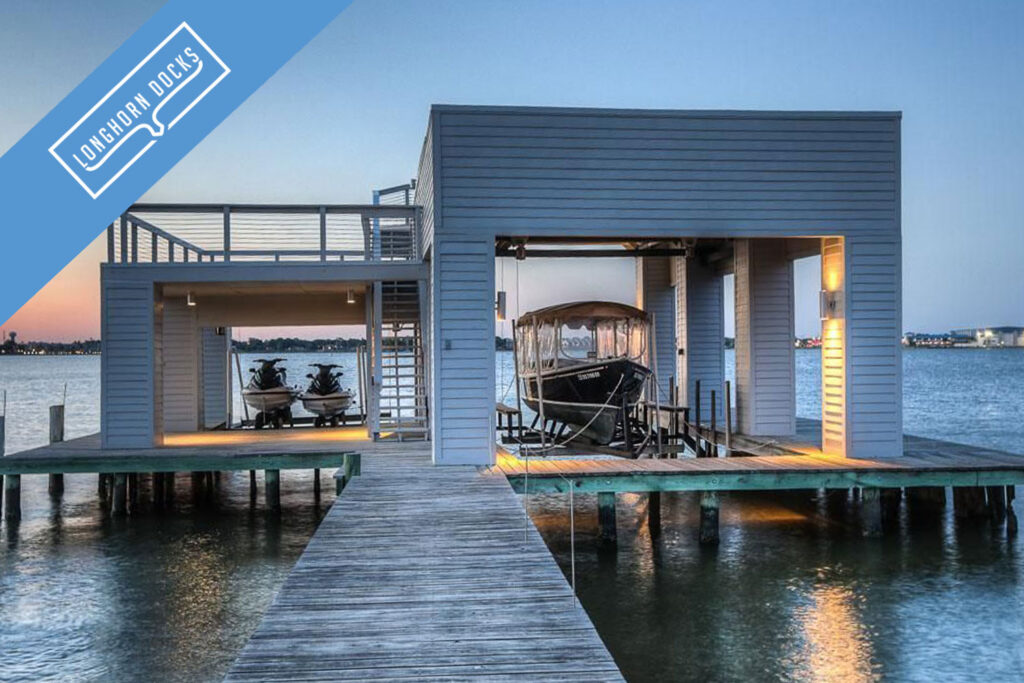
Hydraulic and cable lifts built into the floating structure so they move with the water. Metal roofs rated for Hill Country wind, swim ladders, drive-on PWC ports and lighting, all designed in before the first weld.
Where on Lake Travis We Build
The whole lake, from the dam to Spicewood. Hudson Bend, Lakeway, Steiner Ranch, Lago Vista, Jonestown, Point Venture, Volente, Briarcliff, The Hollows, Spicewood and the Pedernales arm. We are based in Austin at 15202 Kinsey Ct, ten minutes from Mansfield Dam.
Local means we know the coves. The limestone shelf off Hudson Bend, the wake exposure on the main basin near Lakeway, the silt in the Pedernales arm and the steep grades around Briarcliff each change how a dock gets anchored. We have built and repaired docks through two droughts and the 2018 flood.
Aluminum, not wood. Wood docks on Lake Travis typically need replacement within 10 to 15 years. Aluminum frames with composite decking last 25 to 40 years with minimal maintenance.
One project at a time. Your dock gets the full crew until it is done. Google Guaranteed, BBB accredited, licensed and insured, and a sister company of Longhorn Pro Builders.
How a Lake Travis Dock Build Works
1. Site Walk and Depth Survey
We measure water depth at the current level and at the low-water mark, check the shoreline for rock and grade, and note wake exposure. You tell us how you use the water; we tell you what will work.
2. 3D Design and Proposal
You see your dock in 3D before anything is built, placed on your shoreline at full pool and at low water. The itemized proposal has no vague line items.
3. Permits
Most home docks on Lake Travis need no LCRA permit, but they do need your city’s building permit, or a Travis County floodplain permit outside city limits, plus any HOA approval. We check what your lot needs, prepare the drawings from the 3D design, file the applications and manage the review. Our dock permit guide covers who issues what.
4. Build and Launch
Frames are assembled, floated, anchored and finished on site in 3 to 8 weeks. We test the lift, the gangway and the anchors with you before we hand over the keys.
How Much Does a Dock Cost on Lake Travis?
A single-slip aluminum floating dock with gangway on Lake Travis starts around $15,000. Most custom docks we build here, with a lift, roof and quality finishes, land between $25,000 and $75,000. Multi-slip entertainment docks with roofs and lifts run $50,000 to $150,000 or more.
Lake Travis adds cost in two places that Lake Austin does not: longer anchor cables and gangways to cover the water level range, and barge access on steep limestone lots where a truck cannot reach the shoreline. Read our boat dock cost guide for Texas for a full breakdown by dock type and material, or request a site-specific estimate.
Lake Travis Dock FAQs
What is the current water level on Lake Travis?
On October 4, 2026, Lake Travis was at 677.8 feet above sea level, 94.4 percent full, per Water Data for Texas. Full pool is 681 feet. The lake was 84 percent full a year earlier and 74 percent full in April 2026. LCRA publishes the level daily, and we check it before every site walk.
Do floating docks need to be moved when the lake drops?
Usually not. A floating dock built for Lake Travis has anchor cables and a gangway sized for the full range, so it follows the water down. In a severe drought the shoreline can move 100 feet or more and some docks need the gangway extended or the dock walked out to deeper water. We do that as a repair call.
Do I need an LCRA permit for a dock on Lake Travis?
Usually not. LCRA requires no permit, registration or fee for a residential dock of 1,500 square feet or less, though every dock has to meet its safety standards, including the 100-foot limit from shore and encased flotation. Floating docks larger than that are treated as marinas and need an LCRA marina permit. The permit most homeowners do need comes from their city, such as Lakeway or Lago Vista, or from Travis County if the lot is outside city limits. We check what applies before design and file it for you. Our dock permit guide has the details.
How deep does the water need to be for a dock?
A floating dock needs enough depth at the low-water mark to keep the boat and the floats off the bottom, which depends on your boat’s draft and the slope of your shoreline. On the depth survey we measure at the current level and project to the drought low, then set the dock far enough out that it stays usable.
Can you repair my Lake Travis dock after a level drop or a flood?
Yes, including docks we did not build. The common Lake Travis repairs are snapped or stretched anchor cables, gangways that no longer reach, floats that lost buoyancy and storm damage. We prioritize storm and level-change calls and document the damage for your insurance. See our dock repair page.
Lake Travis Dock Services
What Our Clients Are Saying
Ready to Build on Lake Travis?
Tell us where on the lake you are and how you use the water. We will schedule a free site walk and depth survey. Call (512) 200-4244 or fill out the form below.