
Boat Lift Installation in Austin and Lake Travis
Longhorn Docks installs hydraulic, cable and PWC lifts on new and existing docks across Lake Travis and Lake Austin. Installed prices run from about $2,500 for a PWC port to $25,000 or more for a hydraulic lift, and most retrofits finish in one to three days. A lift keeps your hull out of the water, off the algae and away from wake damage, and it pays for itself in bottom cleaning alone.
How Much Does a Boat Lift Cost Installed in Austin?
Installed boat lift prices on Lake Travis and Lake Austin run from about $2,500 for a PWC port to $25,000 or more for a large hydraulic lift. Cable lifts for most runabouts and wake boats land between $5,000 and $15,000. The table shows what we quote most often, installed on an existing dock.
| Lift type | Fits | Installed cost |
|---|---|---|
| PWC lift or drive-on port | Jet skis and small PWCs, one per port | $2,500 to $5,000 |
| Electric cable lift, 4,000 to 6,000 lb | Runabouts, pontoons, bass boats | $5,000 to $10,000 |
| Electric cable lift, 6,000 to 10,000 lb | Wake boats, larger pontoons, cuddies | $9,000 to $15,000 |
| Hydraulic lift, 8,000 to 12,000 lb | Wake boats and cruisers that go out daily | $12,000 to $20,000 |
| Hydraulic lift, 12,000 lb and up | Large cruisers, tritoons with twins | $18,000 to $25,000 or more |
| Lift added during a new dock build | Any of the above | Roughly 10 to 20 percent less than a retrofit |
Basis: Longhorn Docks proposals, 2025 to 2026, Lake Travis and Lake Austin. Installed cost includes the lift, mounting hardware, electrical hookup and testing. Dock reinforcement, a remote control package and canopy are itemized separately when needed.
What moves the number: the weight the lift has to carry, hydraulic versus cable drive, whether your dock frame needs reinforcement to carry it, how far the electrical run is, and remote or premium finishes. Installing the lift during a new dock build is always cheaper than retrofitting because the frame is designed for it from the start. Our boat lift cost guide breaks the prices down by brand and capacity.
Which Lift Type Fits Your Boat?
The rule of thumb we use: under about 8,000 pounds loaded, a cable lift does the job well and costs less. Above that, or if the boat goes out most days, go hydraulic.
Cable lifts use an electric winch and stainless cables to raise a cradle. They are the most common lift on both lakes, cost $5,000 to $15,000 installed, and will run for decades if the cables are inspected each spring and replaced every five to eight years.
Hydraulic lifts raise the boat on hydraulic cylinders in about a minute, run quietly, and have no cables to fray. They cost more, $12,000 to $25,000 or more, but for a wake boat or a cruiser that is in and out every weekend, the speed and the lower maintenance are worth it. Most come with a remote so you can have the boat down before you reach the dock.
PWC lifts and drive-on ports handle jet skis. A port floats at the dock edge and the PWC rides up onto it; a PWC lift is a small cradle lift. Either is $2,500 to $5,000.
Sizing. Take the boat’s dry weight, add fuel, water, batteries, gear and the people on board, then add 20 percent. That is the lift capacity you need. A 5,500-pound wake boat with a full ballast and tank is closer to 8,000 pounds in the cradle, which is why we size from the loaded figure and never from the brochure. The cable versus hydraulic guide and the cradle versus sling guide cover the details.

What Boat Lifts Do We Install?
Hydraulic Boat Lifts
Quiet, fast and low maintenance, with no cables to fray. The right choice for boats from about 8,000 to 20,000 pounds or any boat that goes out most days. Remote control standard. $12,000 to $25,000 or more installed.
Electric Cable Lifts
The workhorse lift on Lake Travis and Lake Austin. An electric winch and stainless cables lift a cradle sized to your hull. Best value for boats up to about 8,000 pounds loaded. $5,000 to $15,000 installed.
PWC Lifts and Ports
Drive-on floating ports and small cradle lifts for jet skis, one per machine, mounted at the dock edge or on their own float. $2,500 to $5,000 installed. See our guide to jet ski dock options.
Lifts Built Into a New Dock
On a new floating or fixed dock we design the frame around the lift from the start, so the slip, the floats and the electrical are all sized for it. It costs 10 to 20 percent less than retrofitting and the result is cleaner. See dock construction.
Do Boat Lifts Work With Lake Travis Water Level Changes?
Yes, when the lift is on a floating dock. The dock and the lift ride up and down with the lake together, so the boat sits at the same height above the water whether Lake Travis is at 640 feet or 681. That is why almost every lift we install on Lake Travis goes on a floating dock, and why the lift’s weight is part of the float calculation from the start.
On a fixed dock, which is common on Lake Austin where the level barely moves, we set the lift’s travel for the normal range and make sure the cradle clears the bottom at low water. A fixed-dock lift on Lake Travis is only workable in a deep cove, and we will tell you if your slip is not one.
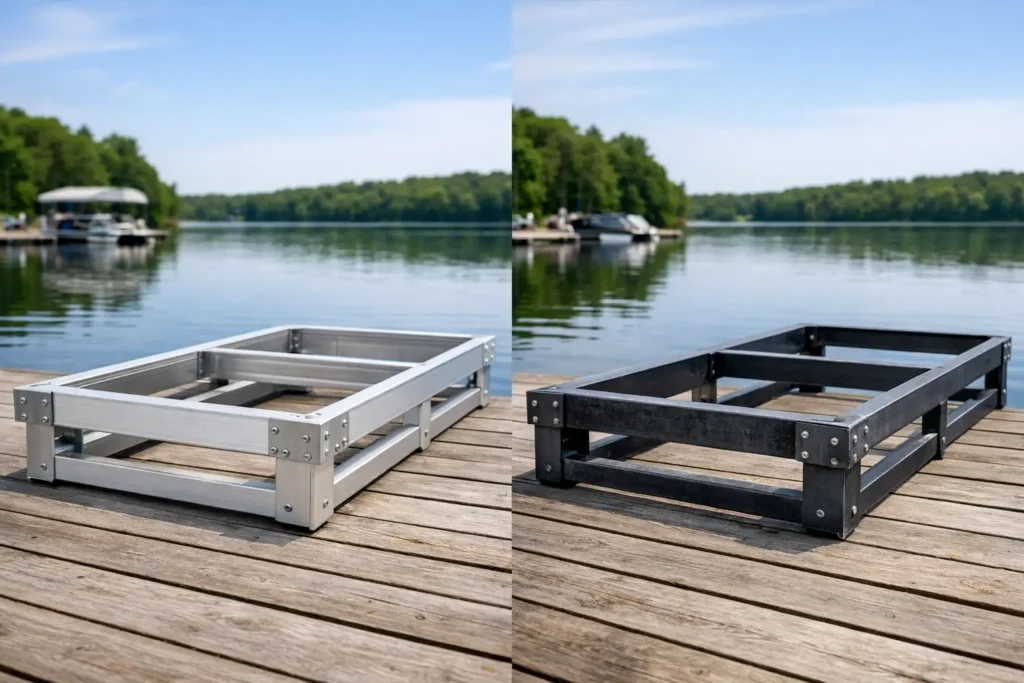
Can you add a lift to an existing dock? Usually. We inspect the frame first. Aluminum and steel frames in good condition take a lift with little or no reinforcement; an older wood dock often needs a doubled stringer or a new header beam under the lift beams, and a floating dock may need added floats to carry the extra weight. We quote the reinforcement as its own line so you can see it. If the frame is not sound enough to carry a lift safely, we say so, and the dock repair estimate comes before the lift.
Which Boat Lift Brands Do We Install and Service?
We install and service the major lift brands sold in Central Texas rather than pushing one line, and we match the brand to the boat and the dock. The ones you will see most on Lake Travis and Lake Austin:
HydroHoist. Floating hydro-pneumatic lifts that raise the boat on air-filled tanks. Popular on floating docks because the lift itself floats; no cradle hardware hanging below the dock.
Sunstream. Hydraulic lifts with fast cycle times and clean lines, including models that mount to floating docks. The usual pick for wake boats that go out daily.
RGC Marine. Hydraulic and cable lifts with heavy capacities, often specified for larger cruisers and for fixed docks on Lake Austin.
ShoreStation and other cable lifts. The dependable mid-range choice for runabouts and pontoons, with parts that are easy to source for years.
Whatever is on your dock now, we can service it: cables, motors, bunks, hydraulic cylinders and controls. If a lift is past saving, we quote the replacement alongside the repair so you can compare. Keeping a lift healthy is mostly spring maintenance, which our guide on how to maintain a boat lift walks through.
How Does a Boat Lift Installation Work?
1. Assessment
Free. We measure your boat’s loaded weight and beam, inspect the dock frame and floats, check water depth at low water, and look at where power can come from. You get a lift recommendation with the capacity math shown.
2. Quote and Selection
Two or three options at different price points with the trade-offs spelled out: cable or hydraulic, brand, capacity, remote. Any dock reinforcement is its own line. No pressure toward the most expensive unit.
3. Installation
Reinforcement first if the frame needs it, then the lift, the electrical hookup and a full load test with your boat in the cradle. Most retrofits take one to three days; a lift that is part of a new dock build goes in with the dock.
4. Training
We walk you through operation, the safety stops, bunk placement for your hull and the spring maintenance checklist before we leave, and we set the cradle so the boat sits level the first time you drive on.
Why Install Your Lift With Longhorn Docks?
We size it right. An undersized lift is a liability and an oversized one is wasted money. We size from the loaded weight of your boat with a 20 percent margin, and we show you the math.
We build docks, so we know what the frame can carry. A lift installer who has never framed a dock guesses at reinforcement. We inspect the structure, reinforce where it needs it, and skip it where it does not.
Floating-dock lifts are our specialty. Most of our work is on Lake Travis, where the lift has to ride with the lake. The float calculation, the cable lengths and the electrical run are designed together.
Honest options. Two or three choices at different prices with the trade-offs in writing. The boat lift that sold best last month is not automatically the one you need.
Local and licensed. Based in Austin, Google Guaranteed, BBB accredited, and on the water at Lake Travis and Lake Austin every week. Robert W. on Lake Travis had us add a second lift during his dock renovation; his review is below.
Boat Lift FAQs
What size boat lift do I need?
Take your boat’s dry weight, add fuel, water, batteries, gear and passengers, then add 20 percent. That is the minimum lift capacity. A 22-foot wake boat listed at 5,500 pounds dry is usually 7,500 to 8,500 pounds loaded with ballast, so it needs a 10,000-pound lift, not a 6,000. We size from the loaded weight on every install.
Can you add a boat lift to my existing dock?
Usually, yes. We inspect the frame and floats first. Aluminum and steel frames in good shape take a lift with little or no reinforcement; an older wood dock often needs a doubled stringer or a header beam, and a floating dock may need extra floats for the added weight. Reinforcement is quoted as its own line. Most retrofits are done in one to three days.
Hydraulic or cable: which boat lift is better?
Under about 8,000 pounds loaded, a cable lift is the better value: $5,000 to $15,000 installed, reliable for decades with cable inspections each spring. Above 8,000 pounds, or for a boat that goes out most days, hydraulic is worth the extra cost: faster, quieter, no cables to replace, $12,000 to $25,000 or more. Our cable versus hydraulic guide has the full comparison.
Do boat lifts work with Lake Travis water level changes?
Yes, on a floating dock. The dock and lift move with the lake together, so the boat stays at the same height above the water through the full range. On a fixed dock the lift’s travel is set for the normal range and has to clear the bottom at low water, which on Lake Travis only works in deep coves. Lake Austin holds a constant level, so fixed-dock lifts are common there.
Do you repair boat lifts?
Yes. Cables, motors, bunks, hydraulic cylinders, controls and full replacements, on most major brands and on lifts we did not install. Lift repairs typically run $300 to $2,500 and finish in one visit. See dock and lift repair for the full price table.
Related Services and Guides
What Our Clients Are Saying

Get Your Boat Out of the Water
Tell us the boat, the lake and what is on your dock today. Call (512) 200-4244 or use the form, and we will come out, size the lift and send you options with the capacity math shown.