
Custom Dock Builder in Austin and the Texas Hill Country
Longhorn Docks builds custom aluminum-frame boat docks on Lake Travis and Lake Austin, from single-slip floating docks starting around $15,000 to multi-slip covered docks at $50,000 to $150,000. We handle the design, the LCRA permit and the build, and most projects go from site walk to launch in 10 to 20 weeks.
How Much Does a Custom Dock Cost in Austin?
Most custom docks we build on Lake Travis and Lake Austin cost between $25,000 and $75,000. A single-slip floating dock starts around $15,000. A multi-slip covered dock with lifts and an upper deck runs $50,000 to $150,000 or more. The table shows the ranges we quote most often.
| Dock type | Typical installed cost | What drives it |
|---|---|---|
| Single-slip floating dock, open | $15,000 to $30,000 | Slip size, gangway length, anchoring |
| Single-slip with boat lift and roof | $30,000 to $55,000 | Lift capacity, roof span, lighting |
| Two-slip floating dock, open | $40,000 to $75,000 | Frame size, float count, decking choice |
| Two-slip covered dock with lifts | $60,000 to $110,000 | Two lifts, full roof, PWC ports, railings |
| Multi-slip entertainment dock with upper deck | $90,000 to $150,000 or more | Upper deck structure, stairs, electrical, finishes |
| Fixed dock on piers (Lake Austin) | $35,000 to $90,000 | Pier depth, bottom conditions, City of Austin permit |
Basis: Longhorn Docks proposals, 2025 to 2026, Lake Travis and Lake Austin. Prices include design, permit drawings, materials, labor and launch. The LCRA permit fee and any City of Austin fees are itemized separately.
What moves a quote up or down: slip count and boat size, roof or no roof, lift type, decking (composite costs more than treated wood and far less over 20 years), shoreline access for the barge, and the anchoring a limestone bottom or a steep bank needs. Our 2026 boat dock cost guide breaks every line item down, and every proposal we send is itemized the same way.
Fixed or Floating: Which Dock Works on Your Lake?
It depends on which lake you are on. On Lake Travis, build floating. The lake is a flood-control reservoir that has moved more than 50 feet between its record low and record high, so a dock has to ride up and down with it. A floating dock on long anchor cables with an articulating gangway does that; a fixed dock ends up high and dry in a drought or underwater in a flood. We build fixed docks on Lake Travis only in deep, protected coves where the bottom drops off fast.
On Lake Austin, you have a choice. The LCRA holds the lake within about a foot of full pool year round, so a fixed dock on steel or concrete piers works and many owners prefer the solid feel and the roof it can carry. Floating docks work there too and cost less to install. Either way the dock has to meet City of Austin size and setback rules as well as LCRA rules.
Every lot is different beyond the lake it sits on: limestone shelves, steep grades, shallow coves, wake exposure. We design each dock for the exact conditions on your shoreline rather than dropping a kit on it, and we take on one major build at a time so the crew is on your project until it is done. Our floating dock page and the guide to docks on lakes with changing water levels go deeper on the trade-offs.
What Is Included in a Longhorn Dock Build?
Site Assessment and Engineering
We walk your shoreline, measure water depth at the current level and at the low-water mark, map the bottom and the grade, and size the anchoring for your lake bed. On Lake Travis that means cable lengths that still hold at 640 feet; on Lake Austin it means piers set to the right depth in the right bottom. The 3D design you approve becomes the permit drawing.
LCRA and City Permitting
We prepare the drawings, file the LCRA application for Lake Travis and Lake Austin, and handle the City of Austin review that Lake Austin docks also need. You never decode the regulations yourself, and we do not order materials until the permit is in hand.
Aluminum Frame Construction
Marine-grade aluminum framing that will not rot, warp or rust, welded and bolted with stainless hardware. Encapsulated floats on floating docks, so the foam never waterlogs. Composite or ipe decking on top, for a dock that looks the same in year 20 as it does on launch day.
Lifts, Roofs, and Finish Work
Hydraulic, cable and PWC lifts sized to your boat, metal roofs, LED lighting and marine electrical, glass or cable railings, swim ladders and bumpers. All of it is designed in from the start and installed during the build, so nothing is bolted on as an afterthought.
Aluminum or Wood: Which Dock Frame Lasts on a Texas Lake?
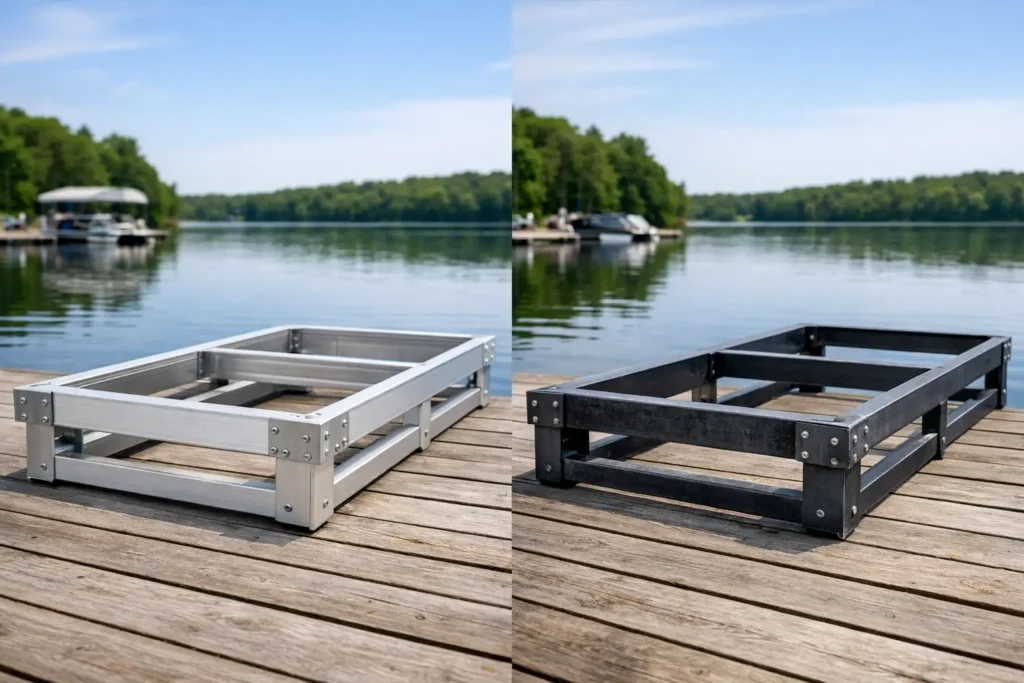
Aluminum. It costs more on the day you buy it and far less over the life of the dock. Wood-frame docks in Central Texas typically need replacing within 10 to 15 years; the heat, the UV, the wet-dry cycle at the waterline and the wake traffic eat them from the joists out. An aluminum frame with composite decking is a 25 to 40 year structure with no painting, sealing or rot.
Where the money goes. On a two-slip dock the aluminum frame adds roughly 15 to 25 percent to the upfront price compared with treated pine. Over 20 years the wood dock will have been re-decked at least once and probably replaced, which puts its total cost well above the aluminum one before you count the weekends spent sealing it.
Steel is the other option, and it is strong, but on Lake Travis and Lake Austin it rusts at the waterline unless it is galvanized and maintained. We build aluminum because it is the lightest, lowest-maintenance frame that still carries a roof and two lifts. The full comparison is in our guide to aluminum versus steel dock frames.
Decking. We put composite or ipe on top. Composite stays cooler underfoot than you expect, does not splinter, and is the right call for most owners. Ipe is the premium choice for a natural wood look that still lasts decades. Both are covered in our composite dock boards guide.
How Long Does a Dock Build Take on Lake Travis, and What Does the LCRA Permit Involve?
Plan on 10 to 20 weeks from site walk to launch. The permit is the long pole: the LCRA takes 30 to 90 days to review a dock application on Lake Travis, and a Lake Austin dock adds a City of Austin review on top. Construction itself is 3 to 8 weeks depending on size, and we give you a firm build schedule with your proposal.
What the LCRA needs. A site plan showing the dock on your lot with distances to the property lines and the shoreline, structural drawings, the dock’s dimensions and square footage, proof of ownership or the owner’s consent, and the fee. Docks have to stay inside the lot’s projected lines, under the size limits for the lake, and clear of navigation channels. On Lake Austin the City of Austin adds its own size, height and setback limits under the Land Development Code, and both approvals have to be in hand before we start.
What we do with it. The 3D design you sign off on becomes the drawing set. We file the application, answer the reviewer’s questions, and schedule materials to arrive the week the permit clears. Spring is the busy season for both the LCRA and the lake, so a dock you want for Memorial Day should start its paperwork in January. Our guide to Texas dock permits covers the rules lake by lake, including Lake LBJ and the upper Highland Lakes.

How Does the Dock Building Process Work?
1. Site Walk
Free. We measure depth at today’s level and the low-water mark, check the shoreline, grade and access, and talk through boats, lifts, roof and how you use the water. Usually within a week of your call.
2. 3D Design and Proposal
You see your dock in 3D on your own shoreline before anything is ordered, and you get an itemized proposal with a price for every line: frame, floats or piers, decking, lift, roof, electrical, permit. No allowances, no vague line items.
3. Permitting
Your approved design becomes the permit drawings. We file with the LCRA, and with the City of Austin for Lake Austin, and manage the review. Most permits clear in 30 to 90 days, and materials are scheduled to land the week they do.
4. Construction
Frames are welded, floated or set on piers, anchored and finished on site over 3 to 8 weeks by one crew that stays on your job until it is done. You get regular updates and a final walkthrough before we hand you the lift remote.
Why Do Austin Homeowners Choose Longhorn Docks?
Aluminum, not wood. We watched neighboring wood docks fall apart in under a decade, so we build aluminum frames with composite decking. Less maintenance, longer life, lower cost over time.
One major build at a time. Your dock gets the full crew and the full attention of the owner. Projects finish on schedule because we are not juggling four job sites.
Design through delivery, in house. As a sister company of Longhorn Pro Builders we run the whole process ourselves: 3D renderings, permits, construction and the final walkthrough. One point of contact from the first site walk to the day you tie off your boat.
Local to both lakes. Based in Austin, on the water at Lake Travis and Lake Austin every week, Google Guaranteed and BBB accredited. Recent work includes a renovation with a second lift for Robert W. on Lake Travis and a full modernization for Andrew H. on Lake Austin; their words are in the reviews below. If you are weighing builders, our guide on how to choose a dock builder in Austin lists the questions to ask any of us.
Dock Construction FAQs
How long does it take to build a dock on Lake Travis?
Plan on 10 to 20 weeks from site walk to launch. The LCRA permit takes 30 to 90 days, then construction runs 3 to 8 weeks depending on the size of the dock and whether it carries a roof and lifts. We give you a firm schedule with your proposal, and starting the paperwork in January is the way to have a dock for Memorial Day.
Do I need a permit to build a dock in Austin?
Yes. Every new dock on Lake Travis and Lake Austin needs an LCRA permit, and a Lake Austin dock also needs City of Austin approval under the Land Development Code because the lake sits inside the city limits. We prepare the drawings from your approved 3D design, file both applications and handle the reviewer’s questions. You do not deal with either agency yourself.
Aluminum or wood: which is better for a dock frame?
Aluminum. It costs roughly 15 to 25 percent more upfront than a treated-pine frame and far less over the life of the dock. Wood docks in Central Texas typically need replacement within 10 to 15 years; an aluminum frame with composite decking lasts 25 to 40 years with no sealing, painting or rot. Every dock we build is aluminum.
Can you build a dock on a rocky or steep shoreline?
Yes. Most of Lake Travis is limestone with steep banks, and it is where we build most of our docks. A floating dock avoids drilling the bottom; we anchor to the shore and to the lake bed with cable lengths sized for the full range of the lake, and an articulating gangway handles the grade. On a steep lot the gangway and the stairs down to it are usually the part that takes the most design work. Our dock pilings guide covers what rock and soft bottoms each need.
Where does Longhorn Docks build?
Lake Travis and Lake Austin are our home water, including Lakeway, Spicewood, Hudson Bend, Steiner Ranch, Westlake and River Place. We also build on Lake LBJ, Lake Marble Falls, Inks Lake and Lake Buchanan, about an hour from Austin in any direction. See all of our service areas.
Related Services and Guides
What Our Clients Are Saying

Ready to Build Your Dock?
Tell us which lake you are on, what you keep on the water and how you want to use the dock. Call (512) 200-4244 or use the form, and we will schedule a free site walk and send a 3D design with an itemized proposal.