
Floating Dock Builder in Austin and the Texas Hill Country
Floating docks are the right choice on Lake Travis, where the level has moved more than 50 feet between drought and flood. Longhorn Docks builds aluminum floating docks with encapsulated floats and articulating gangways, from about $15,000 for a single slip to $60,000 and up with a lift and roof. The dock rides with the lake, so your boat sits at the same height whether the water is at 640 feet or 681.
How Much Does a Floating Dock Cost in Austin?
A single-slip aluminum floating dock with a gangway starts around $15,000 on Lake Travis and Lake Austin. Most of the floating docks we build land between $25,000 and $60,000, and a two-slip covered dock with lifts runs $60,000 to $110,000. The table shows the ranges we quote most often.
| Floating dock | Installed cost | Per square foot |
|---|---|---|
| Single slip, open, with gangway | $15,000 to $30,000 | $45 to $70 |
| Single slip with lift and roof | $30,000 to $55,000 | $70 to $110 |
| Two slip, open | $40,000 to $75,000 | $45 to $70 |
| Two slip, covered, with two lifts | $60,000 to $110,000 | $80 to $130 |
| Entertainment dock with upper deck | $90,000 to $150,000 or more | $110 to $180 |
| Swim platform or PWC float, added | $3,000 to $8,000 |
Basis: Longhorn Docks proposals, 2025 to 2026, Lake Travis and Lake Austin. Installed cost includes design, permit drawings, aluminum frame, encapsulated floats, decking, gangway, anchoring, delivery and launch. Per-square-foot figures are the dock surface including slips. LCRA and City of Austin fees are itemized separately.
What moves the number: the slip count and size, roof or no roof, lift type, composite versus ipe decking, how long the gangway has to be to reach a usable depth at low water, and the anchoring a limestone bottom or a steep bank needs. Shoreline access for the barge matters too; a dock we can float in from a nearby ramp costs less than one that has to be built in sections on a tight lot. The 2026 boat dock cost guide has the full breakdown by line item.
Floating or Fixed: Which Is Right for Lake Travis and Lake Austin?
Lake Travis: floating, almost always. The lake is a flood-control reservoir. Full pool is 681 feet, the record low was 614 in 1951, the record high 710 in 1991, and it dropped more than 40 feet in the 2022 to 2023 drought. A fixed dock built at any one level ends up stranded on dry rock or under water within a few years. A floating dock on long anchor cables rides the whole range, and the articulating gangway keeps the walk to shore workable. We build fixed docks on Lake Travis only in deep, protected coves where the bottom drops away fast.
Lake Austin: either works, and the choice is about feel and budget. The LCRA holds Lake Austin within about a foot of its 492.8-foot full pool all year, so a fixed dock on steel or concrete piers is stable and many owners like the solid feel and the roof it carries. A floating dock on Lake Austin costs less to install, needs no piers driven into the bottom, and is easier to modify later. Both have to meet City of Austin size and setback rules.
The quick test. If the water in front of your lot can change by more than a few feet in a year, float. If it holds steady and you want a dock that never moves underfoot, piers are an option. Lake LBJ, Lake Marble Falls and Inks Lake are constant-level like Lake Austin; Lake Buchanan moves like Travis. Our guide to floating dock options for Texas homeowners compares the systems in more depth, and the Lake Travis and Lake Austin pages cover each lake’s rules.

What Makes a Floating Dock Last on a Texas Lake?
Aluminum Frame and Encapsulated Floats
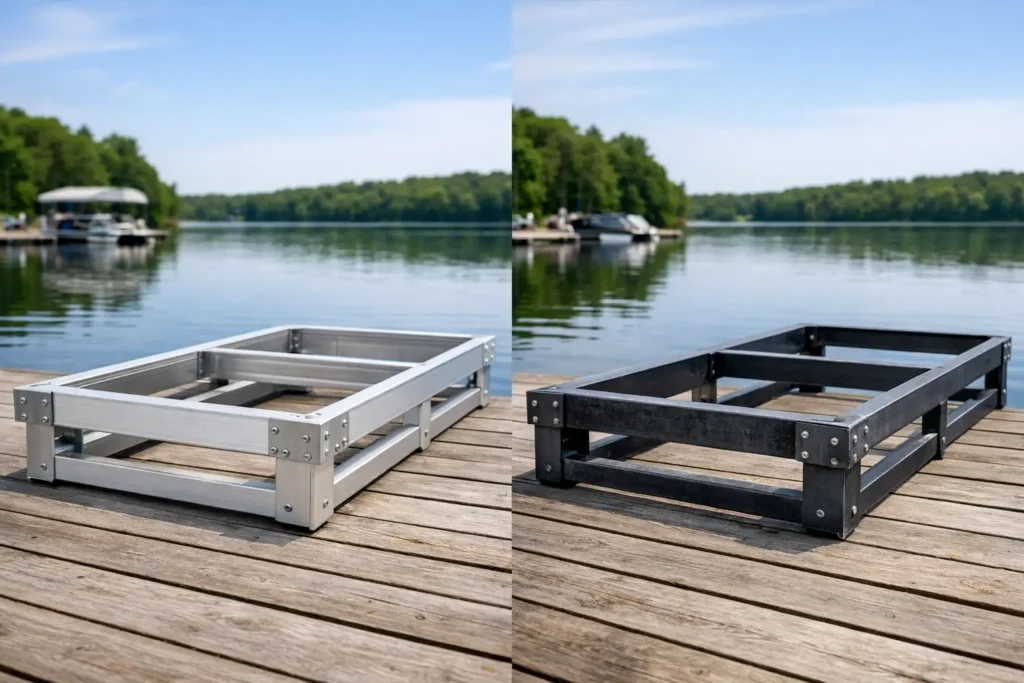
Marine-grade aluminum will not rot, rust or warp, and it weighs a third of steel, so the floats carry more dock and less frame. Encapsulated floats have a hard polyethylene shell around the foam, so they never waterlog the way bare foam blocks do. Together they are the difference between a 12-year dock and a 30-year one.
Composite or IPE Decking
Composite boards do not splinter, fade or need sealing, and stay cooler underfoot than the dark ones you remember from a decade ago. Ipe is the premium hardwood choice for a natural look that still lasts 25 years or more. Both are screwed to the aluminum frame with stainless hardware.
Articulating Gangways
The gangway hinges at the shore landing and rolls on the dock, so it stays walkable as the lake rises and falls. On Lake Travis we size it for the full range, which often means 30 to 50 feet with handrails, so the walk down at low water is a slope rather than a ladder.
Anchoring for a Limestone Shoreline
Most of Lake Travis is rock. We anchor with cable and winch systems to shore anchors set into the limestone and to lake-bed anchors sized for the full range of the lake, so the dock holds position at the record high and the drought low without a diver every time the level moves.
Roofs, Lifts, and Extras
A floating dock can carry a boat lift, a roof, lighting and a swim platform, as long as the floats are sized for the weight from the start. We design the lift and roof into the float calculation rather than adding them later, which is why a lift on a new dock costs less than a retrofit. See boat lift installation.
How Long Does a Floating Dock Last, and What Happens in a Flood?
25 to 40 years. An aluminum frame with encapsulated floats and composite decking has no part that rots or rusts. What wears out is the hardware: anchor cables every 8 to 12 years, gangway rollers and hinges, lift cables, and the occasional float that takes a hit. Budget a spring inspection and you will replace parts, not the dock. A wood-frame floating dock on the same water typically needs rebuilding within 10 to 15 years. Our guide on how long docks last compares the materials.
In a flood, a properly anchored floating dock rides up with the water. The cables are set with enough length for the record high, the gangway swings up with it, and the dock floats above the mess. The failures we see after a flood are cables that were set too short for low water and never lengthened, debris from the Pedernales and Colorado arms piling against the frame, and gangway landings that were too close to the water. All three are design choices, and we make them for the whole range of the lake, not the level on the day we launch.
In a drought, the opposite problem. A dock in a shallow cove can reach the bottom and sit crooked, cables go slack, and the gangway steepens. We size the gangway for low water, set anchors that still hold with slack cables, and when a cove dries out entirely we can move the dock to deeper water for the season and bring it back. Lake Travis has done this to a lot of docks; our water levels guide explains what each 10-foot band means for yours.
How Do We Build a Floating Dock?
1. Site Walk and Depth Survey
Free. We measure water depth at today’s level and at the low-water mark, map the bottom, check the grade for the gangway landing and look at wake exposure and barge access. On Lake Travis the low-water depth decides where the dock can sit.
2. 3D Design
You see the slip layout, lift placement, roof, gangway and finishes in 3D on your own shoreline, with an itemized proposal priced line by line. The float calculation covers everything the dock will carry, including the boat.
3. LCRA Permit
The approved design becomes the permit drawings. We file with the LCRA, and with the City of Austin on Lake Austin, and manage the review. Typically 30 to 90 days. See our Texas dock permit guide.
4. Build and Launch
Frames are welded, floated, anchored and finished on site in 3 to 8 weeks. We load-test the floats with your boat in the slip, cycle the lift, set the cable lengths for the full range of the lake and walk you through it before we hand over the remote.
Why Longhorn Docks for Your Floating Dock?
Built for this lake. We have built and repaired floating docks on Lake Travis through flood years and drought years, and every design choice we make, cable length, gangway length, float margin, comes from watching what fails when the level moves.
Aluminum and encapsulated floats, every time. We do not build wood-frame floating docks or use bare foam. The materials cost more on day one and far less over 30 years.
Lifts and roofs designed in, not bolted on. The float calculation includes the boat, the lift and the roof from the first drawing, so the dock sits level loaded and nothing has to be added later.
One major build at a time. Your dock gets the full crew until launch. 3D design, LCRA permit, build and walkthrough, all in house with one point of contact.
Local and licensed. Based in Austin, Google Guaranteed, BBB accredited, and on the water at Lake Travis and Lake Austin every week. If you are comparing builders, our guide on how to choose a dock builder in Austin lists the questions to ask.
Floating Dock FAQs
Floating or fixed dock: which is better for Lake Travis?
Floating, almost always. Lake Travis has moved more than 50 feet between its record low and record high and dropped more than 40 feet in the last drought, so a fixed dock built at any one level ends up stranded or submerged. A floating dock on long anchor cables with an articulating gangway rides the whole range. Fixed docks on Lake Travis only make sense in deep, protected coves.
How long do aluminum floating docks last?
25 to 40 years or more. The aluminum frame, encapsulated floats and composite decking have no part that rots or rusts. What you replace over that life is hardware: anchor cables every 8 to 12 years, gangway rollers, lift cables and the occasional float. A wood-frame floating dock on the same water typically needs rebuilding within 10 to 15 years.
Can a floating dock carry a boat lift?
Yes. A floating dock carries a cable or hydraulic lift as long as the floats are sized for the boat’s loaded weight plus the lift, and the frame is built to take the lift beams. We design the lift into the float calculation from the first drawing, which is why a lift on a new dock costs 10 to 20 percent less than retrofitting one. HydroHoist-style floating lifts are another option on floating docks because the lift itself floats.
What happens to a floating dock in a flood or a drought?
In a flood a properly anchored floating dock rides up with the water; the cables are set with enough length for the record high and the gangway swings up with the dock. In a drought the risks reverse: a dock in a shallow cove can reach bottom and sit crooked, and the gangway steepens. We size cables, anchors and the gangway for the full range of the lake, and when a cove dries out we can move the dock to deeper water for the season.
Do you build floating docks on Lake Austin and Lake LBJ?
Yes. Lake Austin and Lake LBJ are constant-level lakes, so a floating dock there is a choice rather than a necessity; it costs less than a pier dock to install and is easier to modify later. Lake Austin docks also follow City of Austin size and setback rules. We build on Lake Travis, Lake Austin, Lake LBJ and the upper Highland Lakes; see all of our service areas.
Related Services and Guides
What Our Clients Are Saying

Let's Design Your Floating Dock
Tell us which lake and cove you are on and what you keep on the water. Call (512) 200-4244 or use the form, and we will schedule a free site walk and depth survey and send a 3D design with an itemized proposal.