
Boat Dock Repair in Austin and Lake Travis
Longhorn Docks repairs boat docks on Lake Travis and Lake Austin, including docks we did not build. Most repairs run $300 to $10,000 and finish in one to three days. You get a free inspection and a written estimate before any work starts, and the crew that fixes your dock is the same crew that builds them.
How Much Does Dock Repair Cost in Austin?
Most dock repairs on Lake Travis and Lake Austin cost between $300 and $10,000. A deck board or a lift cable is a few hundred dollars. Pilings, anchor systems and storm damage sit at the top of the range. The table shows what we quote most often.
| Repair | Typical cost | Time on site |
|---|---|---|
| Deck boards, ladders, bumpers and hardware | $300 to $1,500 | Same day |
| Framing: joists, stringers and band boards | $1,500 to $6,000 | 1 to 3 days |
| Float replacement and re-leveling | $800 to $5,000 | 1 to 2 days |
| Pilings, anchor cables and winches | $1,500 to $10,000 | 1 to 3 days |
| Boat lift repair: cables, motors, bunks, controls | $300 to $2,500 | 1 visit |
| Storm and flood damage | $1,000 to $10,000 or more | 1 to 5 days |
Basis: Longhorn Docks repair quotes, 2025 to 2026, Lake Travis and Lake Austin. Every job gets a written, itemized estimate after a free inspection, and the price does not change unless we find something new and you approve it.
What moves a repair up or down the range: how much of the structure is involved, whether the dock is floating or fixed, barge access to the shoreline, and whether the frame is aluminum, steel or wood. Repairs on Lake Travis after a big level change often involve anchor cables and gangways, which is why the piling and anchor line runs higher there. If a repair estimate climbs past about a third of what a new frame would cost, we will tell you, because at that point renovation usually costs less over five years.
Why Do Small Dock Problems Turn Into Big Ones?
Because water never stops working on a dock. A loose board lets rain into the joist below it, and the joist rots from the inside. A cracked float takes on water a cup at a time until one corner sits low, and then every wake loads the frame unevenly. A lift cable that is fraying today snaps with your boat on it next spring.
Central Texas adds two problems of its own. Lake Travis has moved more than 50 feet between its record low and record high, so anchor cables, gangways and float lines take a beating every time the level changes. Lake Austin stays level, but it carries heavy wake traffic and the docks there are often older and fixed on piers, so the weak points are pilings, connections and decking.
Longhorn Docks fixes what is broken, tells you plainly what is about to break, and leaves the rest alone. Because we build docks, we already know how they fail, and most repairs are diagnosed on the first visit. If you want to check your own dock first, our guide to the eight warning signs of structural damage walks through what to look for.
What Dock Problems Do We Repair?
Decking and Framing
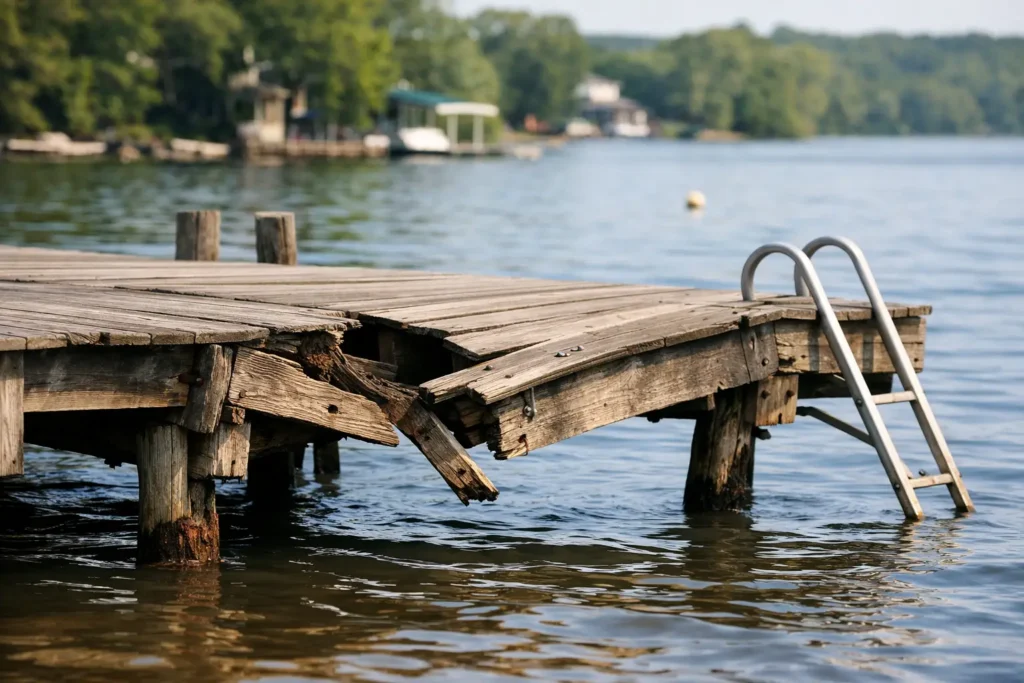
Warning signs: soft or springy boards, splinters, nail heads lifting, a joist you can push a screwdriver into. We replace rotted boards and failing joists, stringers and band boards, and can switch wood decking to composite while the frame is open.
Floats and Flotation
Warning signs: one corner sitting low, the dock rocking more than it used to, foam crumbs in the water. We replace waterlogged or cracked floats with encapsulated ones, re-level the dock and restore the buoyancy a changing lake level needs.
Pilings, Anchors and Cables
Warning signs: a fixed dock that leans or wobbles, a floating dock that has drifted, slack or rusted anchor cables, a gangway that no longer sits square. We repair or replace pilings, cables, winches and anchor systems. This is the most common Lake Travis call after a big level swing.
Boat Lift Repair
Warning signs: a lift that is slow or hums without moving, a frayed or kinked cable, a cradle that comes up uneven. We service cables, motors, bunks, hydraulic cylinders and controls on most major brands, and we can replace a unit that is past saving.
Storm and Flood Damage
Warning signs: anything bent, shifted or missing after a storm, a dock that rode up onto the shoreline, or one that went under during a flood. We stabilize first, document everything for your insurance claim, then repair.
Repair or Replace: How Do You Decide?
Start with the frame. If the frame is sound and the problem is decking, floats, a lift or hardware, repair it. If the frame itself is rotted, rusted through, or undersized for the boat you have now, replacement almost always costs less over five years than a string of patches.
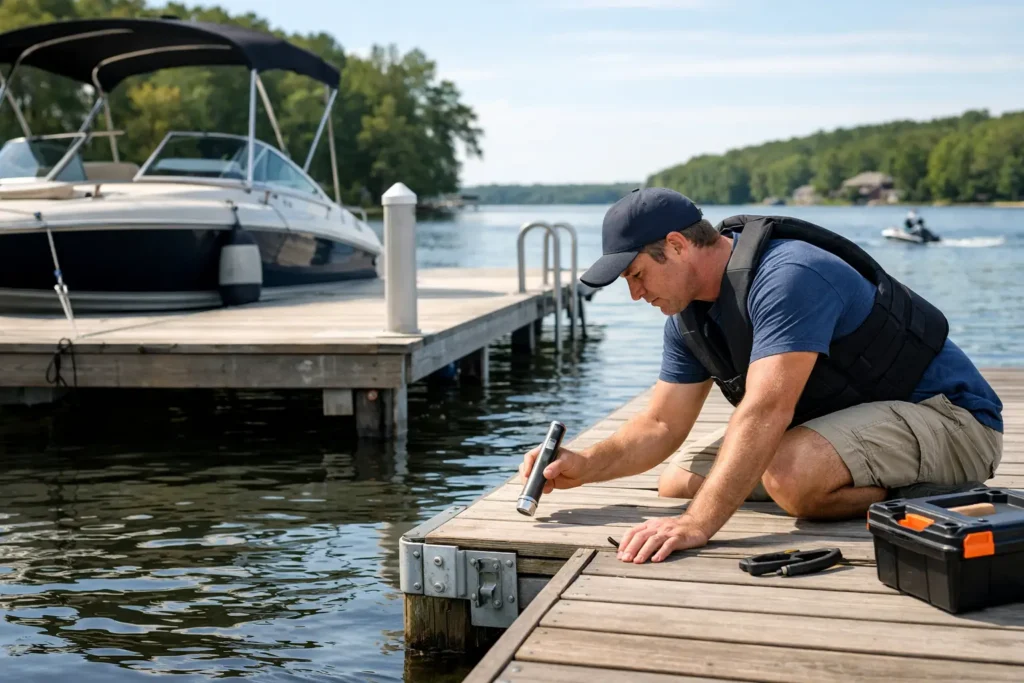
The frame test we use on site. On a wood frame, a screwdriver pushed into a joist should stop at the surface; if it sinks in, the wood is gone. On a steel frame, we look for scale and pitting at the waterline and at every weld. On aluminum, we check the connections and welds, since the members themselves rarely fail. Three or more failed members in a row usually means the rest are close behind.
The cost line. When repair quotes add up to about a third of the cost of a new frame, we stop recommending repair. Past that point you are paying new-dock money for an old dock. We will show you both numbers side by side.
What replacement looks like. On most lots we can rebuild on the existing footprint and anchoring, which often avoids a new permit and keeps the cost between $20,000 and $60,000. Our guide on when to repair and when to replace a dock goes deeper, and the before-and-after renovation results show what a rebuilt dock looks like.
Do I Need a Permit to Repair a Dock on Lake Travis or Lake Austin?
Usually not for a like-for-like repair. Replacing boards, floats, cables, a lift motor or a rotted joist with the same thing in the same place is maintenance, and on Lake Travis the LCRA does not require a new permit for it. The same is true for the City of Austin on Lake Austin.
You do need a permit when the repair changes the structure: a bigger footprint, a new slip, a roof where there was none, a taller profile, or moving the dock to a different spot on the shoreline. On Lake Travis that application goes to the LCRA. On Lake Austin it goes to the City of Austin under the Land Development Code, and the LCRA has a say as well. Plan on four to eight weeks for an LCRA permit and longer for the city.
Two more cases catch people out. If your dock was never permitted in the first place, a repair call can be the moment that surfaces, and it is better to sort that out before work starts than after. And if a storm or a flood destroyed more than about half the dock, both agencies treat the rebuild as new construction even if it goes back on the same footprint.
We check the permit status of every dock we repair, prepare the drawings when one is needed, and file the application. You do not deal with the LCRA or the city yourself. Our guide to Texas dock permits covers the rules lake by lake.

What Happens After a Storm or a Water Level Drop?
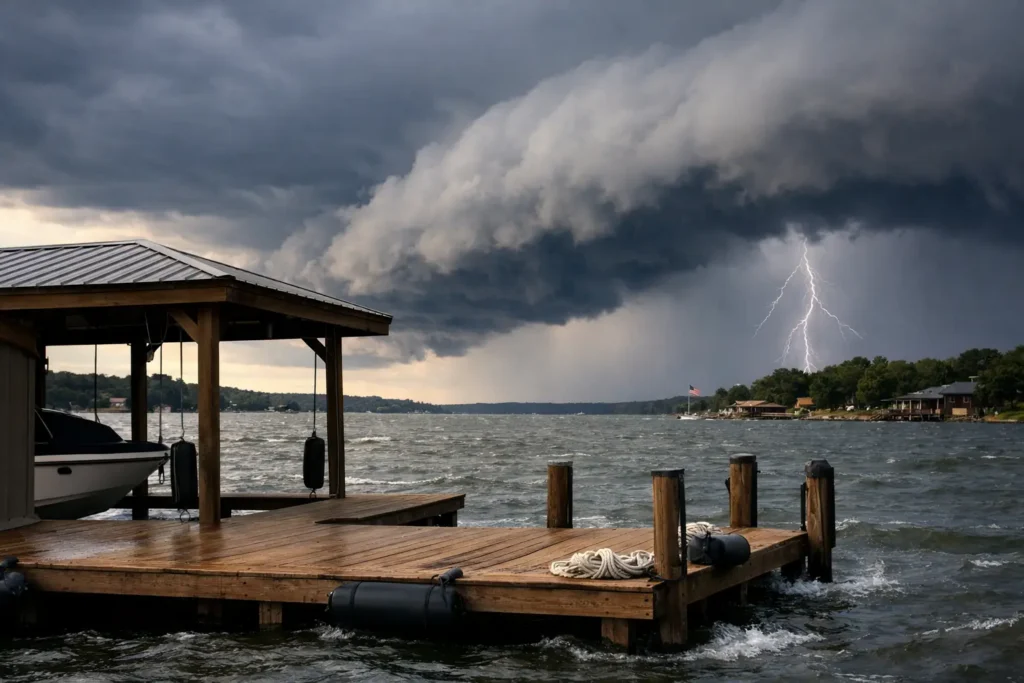
After a storm: call us before you call your insurer. We come out, stabilize anything that is loose or drifting so it cannot do more damage, and photograph and measure everything. That documentation is what your adjuster needs, and most policies cover a dock under the other-structures clause. Storm calls go to the front of the schedule.
After a water level drop on Lake Travis: a floating dock is designed to ride down with the lake, but the parts that connect it to shore are not. Anchor cables go slack or bind, the gangway angle steepens until the hinges and the landing take loads they were never sized for, and a dock that reaches the bottom in a shallow cove will sit crooked and twist its frame. The fixes are usually cable adjustment or replacement, a gangway extension, and sometimes moving the dock to deeper water for the season. If your cove is drying out, our guide to docks on lakes with changing water levels explains the options.
After a flood or a fast rise: the danger runs the other way. Cables that were set for low water can hold a dock under as the lake comes up, and debris coming down the Pedernales and Colorado arms piles against anything in its path. After the water settles we check cable lengths, anchors, floats and the gangway landing, and we clear what the lake left behind. Our storm preparation guide covers what to do before the next one.
How Does a Longhorn Dock Repair Work?
1. Free Inspection
We walk the whole dock, not just the part you called about: frame, connections, floats or pilings, anchoring, lift, electrical and gangway. Usually within a week of your call, sooner after a storm.
2. Written Estimate
An itemized estimate with three priority levels: fix now, fix this season, and watch. You decide what to approve. Nothing starts without your sign-off and nothing gets added without it either.
3. Repair
Most repairs finish in one to three days. Larger structural work gets a firm schedule. When we replace a part we upgrade it: composite over wood, aluminum over steel, encapsulated floats over bare foam.
4. Final Check
We load-test what we fixed, cycle the lift, walk you through the work, and leave a short list of what to keep an eye on next season.
Why Call Longhorn Docks for Dock Repair?
We build docks, so we know how they fail. A repair crew that has never framed a dock guesses at what is behind the decking. Ours has built it. Most problems are diagnosed on the first visit, and the fix addresses the cause, not the symptom.
Honest diagnosis. You get three lists: fix now, fix this season, watch. We do not sell a rebuild when a repair will do, and we say so in writing when a repair is money wasted.
Fast on the small stuff. One Lake Austin client called about minor work while we had larger projects running. We fit it in on a weekend. Repairs get scheduled around the builds, not behind them.
Better parts going back in. Composite boards, aluminum framing, encapsulated floats and stainless hardware, so the same repair does not come around again in three years.
Local and licensed. Based in Austin, Google Guaranteed, BBB accredited, and on the water at Lake Travis and Lake Austin every week. Recent repair and renovation work includes a dock renovation with a second lift for Robert W. on Lake Travis and a full modernization for Andrew H. on Lake Austin; their reviews are below, and our before-and-after renovation results show what the finished work looks like.
Dock Repair FAQs
Most boat dock repairs on Lake Travis and Lake Austin cost between $300 and $10,000. Small jobs like replacing deck boards, a ladder or a lift cable run $300 to $1,500. Float replacement runs $800 to $5,000, framing repair $1,500 to $6,000, and piling or anchor work $1,500 to $10,000. Storm damage can exceed that. These figures are from Longhorn Docks quotes in 2025 and 2026, and every job starts with a free inspection and a written estimate.
Yes. Most of our repair work is on docks built by other companies, including wood docks, steel-frame docks and older fixed docks on Lake Austin. We can match the original materials or upgrade them during the repair.
Check the frame. If it is sound and the problem is decking, floats, a lift or hardware, repair it. If the frame is rotted, rusted through, or too light for the boat you have now, replacement usually costs less over five years. As a rule of thumb, once repair quotes reach about a third of the cost of a new frame, it is time to rebuild. We give you both numbers side by side.
Not for a like-for-like repair. Replacing boards, floats, cables or a lift motor in the same place is maintenance and does not need an LCRA permit. You do need one if the repair enlarges the dock, adds a slip or a roof, moves it, or rebuilds more than about half of it after a storm. On Lake Austin the City of Austin applies the same logic under its Land Development Code. We check permit status and file any application for you.
Yes. Storm and flood calls go to the front of the schedule. We stabilize the dock first so it cannot do more damage, photograph and measure everything for your insurance claim, then repair. Most homeowner policies cover a dock under the other-structures clause.
Most repairs finish in one to three days on site. Simple jobs like boards, ladders and lift cables are usually done the same day. Piling, anchor and framing work takes one to three days, and large storm repairs up to five. The inspection usually happens within a week of your call, sooner after a storm.
Yes. We service cables, motors, bunks, hydraulic cylinders and controls on cable, hydraulic and PWC lifts from most major brands. Lift repairs typically cost $300 to $2,500 and finish in one visit. If a lift is past saving, we can replace it as part of our boat lift installation service.
Related Services and Guides
What Our Clients Are Saying

Need Your Dock Repaired?
Tell us which lake you are on and what the dock is doing. Call (512) 200-4244 or use the form, and we will schedule a free inspection and send a written, itemized estimate before any work starts.