
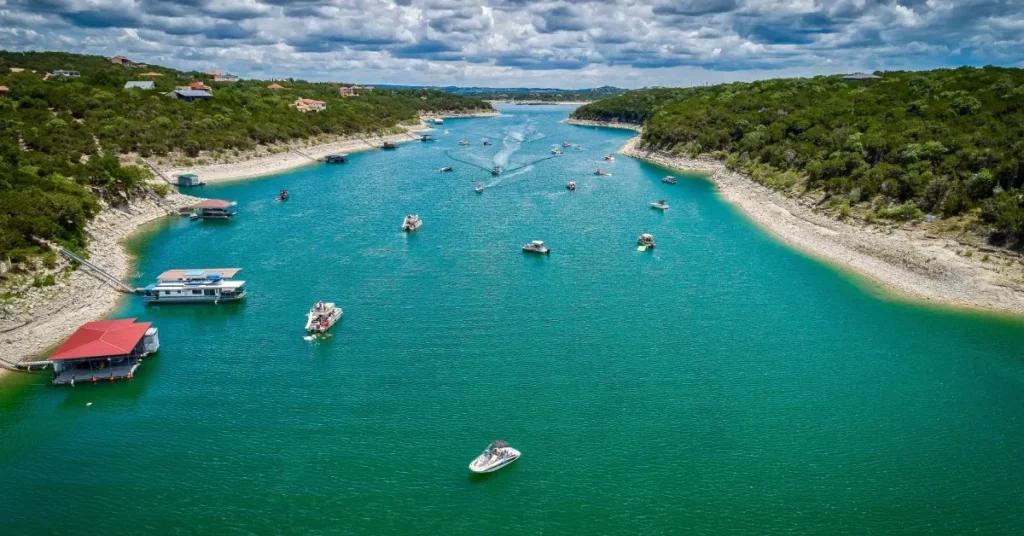
In late 2024, Lake Travis dropped to about 33% of full pool. We watched homeowners haul their fixed-pier docks back from a waterline that had retreated thirty vertical feet. Some were rebuilding pilings out into wet sand. Others had given up entirely and were waiting for the rains. Three properties down from one of those, a floating dock sat exactly where it had always sat (well, lower, but still floating, still useable), with the boat lift attached and water under the keel.
That image, more than any sales pitch, is why most Lake Travis homeowners end up choosing a floating dock.
This isn’t a universal rule. Some lakes hold steady year over year, some properties have geometry that makes a fixed dock the smarter call, and there are real tradeoffs in either direction. But on the Highland Lakes (Travis especially, plus a fair stretch of Lake Austin and Lake LBJ) the math tends to favor floating systems. Here’s the honest version of why, plus what actually goes into a floating dock that lasts longer than its owner does.
The Lake Travis problem in one chart you don’t need
Lake Travis is a flood-control lake before it’s a recreational one. Its job, as far as the LCRA is concerned, is to absorb runoff from the Highland Lakes basin and meter it out to keep Austin from flooding. That means it swings.
A few reference points: 2011 drought lows around 614 feet (about 33% capacity). 2018 floods peaked over 700, topping the dam by 19 feet. October 2024 lows touched roughly 626 feet. Full pool is 681. So in a single decade homeowners watched their lake bounce somewhere on the order of 70 vertical feet at the extremes, and 30 to 40 feet during a normal wet/dry cycle.
A fixed-pier dock, anchored to the bottom and built to a waterline, is engineered for one elevation. It works beautifully right up until the day it doesn’t. Either the lake goes up (your dock is now twelve feet underwater) or the lake goes down (your dock is suddenly a high pier with a long ladder problem and a boat that can’t reach it). Floating docks ride the change. That’s their entire job.
How a floating dock actually works
There are a few pieces, and the difference between a system that lasts decades and one that fails in five years usually comes down to which pieces you got right.
The deck. That’s what you walk on. Underneath sits a frame (aluminum, galvanized steel, or treated wood depending on builder and budget) and beneath that, the floats.
The floats. These are the buoyancy chambers that keep everything on top of the water. The two common technologies are sealed HDPE drums (rotomolded polyethylene shells, foam-filled) and encapsulated EPS billets (foam blocks wrapped in heavy plastic shells). Both work; both have different failure modes. Bare-foam floats (no encapsulation) are still sold by some manufacturers. We don’t recommend them, partly because Hill Country bass and turtles will absolutely chew through unprotected foam over time, and partly because UV degradation eats them from the top.
The anchoring system. This is where floating docks get interesting. You have a few options:
- Piling-and-roller systems. Pilings driven into the lakebed; the dock rides up and down on rollers attached to the pilings. Simplest, most common, very effective when the lake bottom takes pilings cleanly.
- Helical anchors with chain. Screw-in anchors set into the lakebed, connected to the dock by chain. Better choice when the bottom is fractured rock and pilings are unreliable.
- Dead anchors with rode. Concrete deadweights with chain or rope. Usually the least expensive, but also the least controlled (the dock will swing on the anchor radius). Fine for small docks in protected coves; we don’t usually recommend it for a primary dock.
- Combined systems. On bigger docks we’ll often use pilings on the inboard side and chain anchors on the outboard, splitting the load between the two systems.
The gangway. This is the ramp from shore (or from a fixed pier) down onto the floating section. It hinges at the shore end and rolls or slides at the dock end so the angle adjusts as the lake rises and falls. On Lake Travis lots with long vertical drops, the gangway is a serious piece of structure in its own right (sometimes 30 to 40 feet long, articulated, with handrails and lighting that have to keep working as the geometry changes).
Materials, components, and where shortcuts hurt later
Here’s where I get opinionated. (Twenty years of pulling out failed dock hardware will do that to a person.)
Decking. Composite is winning the argument on Hill Country docks for a few reasons. It doesn’t splinter under bare feet in 105-degree summer sun. It doesn’t need to be re-stained every two seasons. It survives the sun-and-soak cycle better than most hardwoods after about year five. Real wood (ipe, garapa, even cedar) still has its place; it just costs more to maintain over a 20-year horizon than people remember when they pick it. We’ve covered the composite dock board tradeoffs in more detail elsewhere if you want the deeper read.
Floats. Buy from someone who’s been around. The float manufacturer matters more than the dock builder, in some ways. We use a small set of vendors whose warranty claims we’ve actually seen honored, and we’ll tell you who if you ask.
Hardware. This is the one place we won’t compromise. Hot-dipped galvanized at minimum on freshwater Hill Country lakes; stainless steel (316, not 304) on any saltwater or brackish job. Bargain hardware corrodes through fast on a floating dock because everything is wet half the time, plus splash-zone salts from sunscreen and boat fuel.
Anchoring. If your builder doesn’t want to talk about lakebed conditions, get a different builder. Pilings driven into fractured limestone without proper sleeving will work loose over a decade. Chain-and-anchor systems sized for a 14-foot boat will not hold a 28-foot wakeboat in a thunderstorm.
We dig into the hardware side of this in our dock pilings guide for anyone considering a piling-anchored design.
When a fixed dock is actually the right answer
Floating docks aren’t always the move. We’ve designed plenty of fixed-pier docks for the right scenarios:
- A lake with stable water levels (Lake Austin, immediately downstream of Lake Travis, holds within about a 4-foot range; fixed docks make sense there).
- A property with an existing seawall or bulkhead at a constant elevation that the dock can simply key into.
- Shallow coves where the bottom is too unconsolidated for piling-and-roller floating systems and too far from anchorage points for chain anchors.
- Specific commercial use cases where the dock surface needs to be at a known fixed elevation regardless of lake conditions.
If your property is on Lake Austin or in a tributary that rarely sees significant drawdown, the conversation should at least include “do we even need this thing to float?” Sometimes the answer is no.
For Lake Travis itself, though, and for most of the Highland Lakes, “do we even need this thing to float?” is a question we can answer pretty quickly.
A representative Lake Travis project
A Spicewood property had about a 40-foot vertical drop from the back patio to full-pool waterline, falling across a 60-foot run of broken limestone shelf. The owners wanted: a usable floating dock with an integrated boat lift, a stable gangway path that worked at full pool and at drought lows, and (this was the design constraint) for the gangway not to look like a gangway. They didn’t want a chunk of industrial articulation visible from the patio.
Our 3D design preview for that one went through six revisions before construction. The final scheme used a hybrid system: a short fixed-pier section walking out over the rock shelf, a 36-foot articulated gangway disguised as a continuation of a stone-edged stair path, and a 30×18 floating dock with a covered boathouse and integrated 7,000-pound boat lift. Anchoring was three pilings on the inboard side (driven into a shelf zone we’d cored before construction to confirm bearing) plus two helical anchors on the outboard side to handle storm loading.
The dock has now ridden three full wet/dry cycles with the lake. Hardware is intact. Owners use it like the patio extension it was designed to be.
Costs, briefly
We don’t quote real numbers in a blog post because the budget range on a custom Lake Travis floating dock is wide enough to be meaningless without site context (anywhere from the mid five figures for a simple replacement to the high six figures for a full custom system with covered boathouse, integrated boat lift, and a long gangway through difficult terrain). For a more grounded breakdown, our boat dock pricing guide walks through the real cost drivers.
Get a 3D preview before you commit
A floating dock is a 25-year asset (longer if you build it right). The decisions you make in the design phase get baked in. We strongly recommend (and we’ll say this until people are sick of hearing it) starting with a design preview, walking the property with a builder who’ll tell you what they actually see, and pricing the project against the real lake-level history of your specific cove.
Request a consult if you’d like us to come out and take a look. We’ll bring a tape measure, a clipboard, and an honest opinion. That’s usually all you need to know whether floating is the right call for your stretch of shoreline.