
Dock Renovation and Replacement in Austin and Lake Travis
When a dock frame is rotted, rusted or too light for the boat you own now, renovating it costs less over five years than another round of patches. Longhorn Docks rebuilds docks on their existing footprint and anchoring, often without a new permit, for $20,000 to $60,000. We keep what is sound, replace the rest with aluminum and composite, and add a lift, roof or upper deck while we are there. Free inspection, written quote, and one crew on your dock until it is done.
What Does a Dock Renovation Cost in Austin?
Most dock renovations we do on Lake Travis and Lake Austin land between $20,000 and $60,000. A re-deck and re-float on a sound frame starts around $8,000. A full frame replacement on the existing floats and anchoring runs $30,000 to $60,000. Adding a lift, roof or upper deck during the rebuild costs 10 to 20 percent less than adding it later, because the frame is sized for it from the start.
| Renovation scope | Typical cost | Time on site |
|---|---|---|
| Re-deck and re-float, frame sound | $8,000 to $20,000 | 3 to 5 days |
| Partial frame rebuild plus new decking | $20,000 to $35,000 | 1 to 2 weeks |
| Full aluminum frame on existing floats and anchors | $30,000 to $60,000 | 2 to 3 weeks |
| Boat lift added during the rebuild | Add $5,000 to $15,000 | Add 1 to 2 days |
| Roof or upper deck added during the rebuild | Add $12,000 to $40,000 | Add 1 to 2 weeks |
| Full replacement on a new footprint (new permit) | $45,000 to $150,000 | See dock construction |
Basis: Longhorn Docks proposals, 2025 to 2026, Lake Travis and Lake Austin. Costs include demolition and haul-off of what we replace, materials, labor and a load test. City, county or City of Austin permit fees, if a permit is needed, are itemized separately.
What moves the number: how much of the frame survives, whether the floats and anchoring are reusable, composite versus ipe decking, and whether the barge can reach the dock or we build in sections from the bank. The 2027 dock pricing guide has the full breakdown by line item, and our dock repair page covers the smaller jobs that stop short of a rebuild.
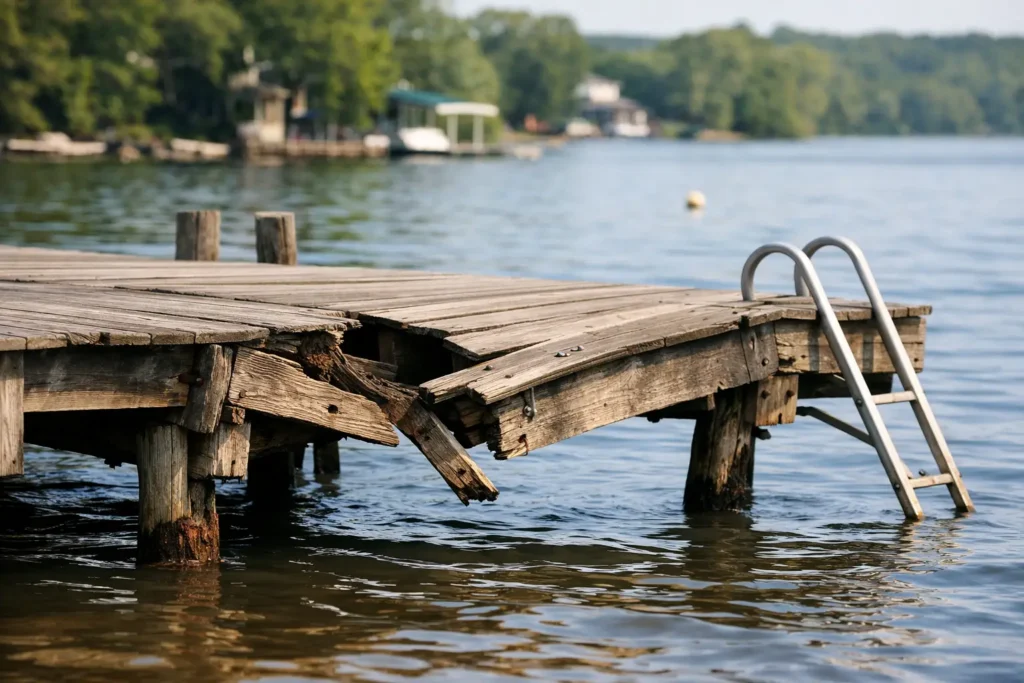
Repair, Renovate or Replace: The Frame Test
Everything on a dock hangs off the frame, so the frame decides the answer. We check three things on the first visit.
Is it sound? Wood frames rot from the inside at the waterline and at every bolt hole. Steel frames rust through at welds and where the galvanizing wore off. If a screwdriver sinks into a wood stringer or a hammer rings dull on steel, the frame is done. That is a renovation, not a repair.
Is it sized for your boat? A frame built for a 3,000-pound runabout in 2005 cannot carry a 7,000-pound wake boat on a lift. Undersized frames bow, hardware works loose, and the lift binds. Adding the lift you want means rebuilding the frame it sits on.
Is the footprint right? If the slip is too narrow, the dock sits in water that is too shallow at low pool, or you want a second slip, that is a replacement on a new footprint, and it needs a new permit.
Sound frame, right size, right footprint, and the problem is decking, floats, cables or a lift: that is a repair, and it is usually a one-to-three-day job. The rule of thumb we give homeowners: once repair quotes reach about a third of the cost of a new frame, renovate. You stop paying for the same dock twice.
What Does a Dock Renovation Include?
Frame and Connections
Rotted wood or rusted steel comes out and a marine-grade aluminum frame goes in, sized for the boat and lift you own now, not the one the dock was built for. Stainless hardware at every connection.
Floats and Anchoring
We test every float and reuse the ones that hold air. Waterlogged or cracked floats get replaced with encapsulated foam-filled units, and the anchoring gets re-checked for the new weight and Lake Travis level swings.
Decking, Rails and Ladders
Composite or ipe decking, cable or aluminum rails that keep the view, swim ladders where people actually get out of the water, and cleats and bumpers placed for your boat.
Lifts and Slips
The rebuild is the cheapest time to add a lift or widen a slip, because the frame is designed for it. Cable, hydraulic and PWC lifts installed and load-tested with your boat. See boat lift installation.
Roof, Upper Deck and Electrical
A roof or upper deck changes the loads, so it goes in with the frame, not on top of it later. Shore power, lighting and lift wiring get rerun to code with GFCI protection, in conduit that survives sun and movement.
Before and After: A Lake Travis Dock Renovation
Robert W. called us about a tired dock on Lake Travis with a single lift and decking that had seen too many summers. The floats and anchoring were still good, so we kept them, rebuilt the frame in aluminum, re-decked in composite, and added a second boat lift during the rebuild instead of bolting one on later.
In his words: “The Longhorn Docks team did an amazing job renovating our dock and adding an additional boat lift. They were very communicative during the process and were able to complete the job ahead of schedule.”
That is the pattern on most of our renovations: keep what holds, replace what does not, and use the rebuild to get the dock you wanted in the first place. The FAQs below cover what changes in a dock’s safety, look and value when the frame is done right, and how to tell when a dock is past repair.
Do I Need a Permit to Renovate My Dock?
On Lake Travis, not from LCRA. LCRA requires no permit for a residential dock of 1,500 square feet or less, new or renovated, as long as it meets the safety standards. A renovation that replaces the floats along with the whole dock has to use encased floats, which we use anyway. Your city, or Travis County outside city limits, may want a permit when the renovation changes the structure: a bigger footprint, a new slip, a roof, or a move along the shoreline. A like-for-like rebuild on the same footprint is the simplest case.
On Lake Austin, the City of Austin decides. Re-decking and repairs that keep the footprint and load-bearing parts qualify for a site plan exemption plus a building permit. Replacing load-bearing beams or pilings, adding walls or enlarging the dock needs a full site plan. A dock built after January 1, 1984 needs proof of its original permit before structural parts can be replaced, and older docks were sometimes built without one on file. LCRA does not regulate docks on Lake Austin.
We check the permit record and the rules for your lot before we quote, so you know up front what the job needs, and we file the application if there is one. The dock permit guide walks through both lakes.

How Long Does a Dock Renovation Take?
Two to six weeks from signed quote to finished dock when no new permit is needed. Aluminum frame material takes one to three weeks to arrive, and the rebuild itself takes three days for a re-deck to three weeks for a full frame with a roof. We run one project at a time, so once your crew starts, they stay until the load test.
If the renovation needs a permit, the review adds time, and a City of Austin site plan on Lake Austin is the longest of them. We start that paperwork the day you sign. Spring fills up fast; if you want the dock back for Memorial Day, call in January or February.
You can usually keep using the dock until the week we start. We stage materials on the bank or a barge, pull the old frame in sections, and most homeowners are back on the water the day we finish.
How Does a Dock Renovation Work?
1. Free Inspection
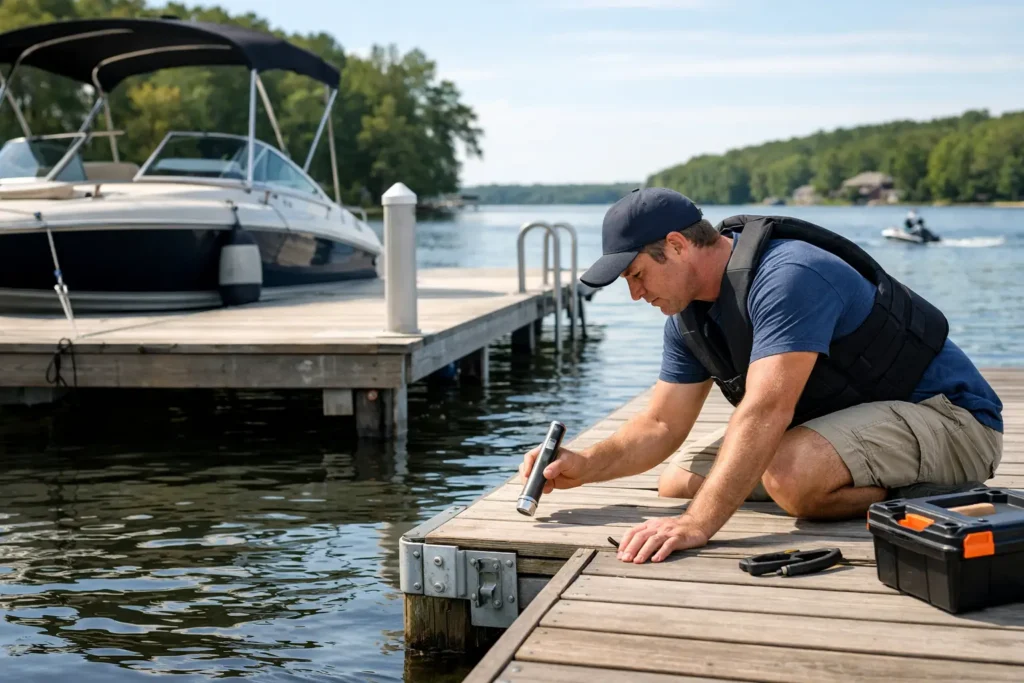
We probe the frame, test every float, check anchors and cables, and pull the permit record. You get a straight answer on repair, renovate or replace, with the frame test results to back it up.
2. Design and Quote
A written quote that lists what we keep, what we replace and what we add. Anything structural, a lift, roof or upper deck, gets a 3D model first so you see the finished dock before material is ordered.
3. Rebuild
Old frame out in sections, new aluminum frame on the floats you keep, then decking, rails, lift, roof and electrical. Three days to three weeks on site, one crew, and the old material hauled off.
4. Load Test and Walkthrough
We load the dock, cycle the lift with your boat in it, check freeboard and anchoring, and walk you through what we built and how to look after it. You get photos of the frame before the decking covered it.
Why Renovate With Longhorn Docks?
We build new docks, so we know what to keep. A crew that only does repairs tends to replace too little; a crew that only builds new tends to replace everything. We frame docks every week, so we can tell you which floats and anchors have ten more years in them and which frame members do not.
Aluminum, not wood. Every frame we put in is marine-grade aluminum. It does not rot, it weighs less so the dock floats higher, and it rides Lake Travis level swings and Lake Austin wake traffic for 30 years or more. You will not be renovating this dock again.
Permit check first. We check the permit record and the rules for your lot before we quote, so you know whether the job needs a permit before you sign anything.
One crew, one project. Your dock gets the whole team from the first cut to the load test. Longhorn Docks is part of Longhorn Pro Builders, Google Guaranteed and BBB accredited, and Chris walks every site himself.
Dock Renovation FAQs
Most dock renovations on Lake Travis and Lake Austin cost $20,000 to $60,000. A re-deck and re-float on a sound frame runs $8,000 to $20,000, a partial frame rebuild $20,000 to $35,000, and a full aluminum frame on the existing floats and anchoring $30,000 to $60,000. A lift adds $5,000 to $15,000 and a roof or upper deck $12,000 to $40,000. These are Longhorn Docks quote ranges from 2025 and 2026, and every job starts with a free inspection and a written estimate.
Renovation is cheaper when the floats, anchoring and permit footprint are still good, because you reuse all three and skip the permit wait. It usually lands at 40 to 60 percent of a new dock. Replacement is the better buy when the footprint is wrong for the boat, the floats are waterlogged, or you want a second slip, because you would be paying to rebuild a layout you do not want. We give you both numbers side by side after the inspection.
Three signs, and any one of them is enough. First, the repair pattern: new boards one season, a framing section the next, then the gangway, then the lift. Add up the last three years of invoices; if the total is a third or more of a renovation quote, you are paying for a rebuild in installments. Second, movement: a persistent lean, one section sitting lower than the rest, a dock that no longer meets its gangway, or hardware that works loose no matter how often you tighten it. Third, fit: the slip is too small for the boat you own now, there is no safe place to swim or board, or guests crowd the walkway. A dock can be structurally fine and still be the wrong dock. We walk all three with you at the free inspection.
The structure changes more than the surface. Before: narrow walkways, an undersized slip, a steep gangway at low water, dated wiring, worn floats and little usable deck beyond the boat. After: a wider main deck with separate boarding and lounging space, a slip and lift sized for the boat, a gangway that works across the lake’s full range, GFCI-protected circuits with lighting where you use it, new floats set for the right freeboard, and decking and rails chosen for sun and moisture. The case study above shows one Lake Travis dock through that change.
Not from LCRA. LCRA requires no permit for a residential dock of 1,500 square feet or less on Lake Travis, renovated or new, as long as it meets the safety standards. Your city, or Travis County outside city limits, may require a permit if the renovation enlarges the dock, adds a slip or roof, or moves it. On Lake Austin, the City of Austin regulates docks: re-decking and same-footprint repairs need a site plan exemption and a building permit, and replacing beams or pilings needs a full site plan. We check the permit record before we quote and file the application if one is needed.
Yes. Most of our renovations are on docks built by other companies, including wood docks, steel-frame docks and older fixed docks on Lake Austin. We reuse what is sound and replace the rest with aluminum and composite, and we can match an existing boathouse or roof line if you want the look kept.
Two to six weeks from signed quote to finished dock when no permit is needed: one to three weeks for aluminum material to arrive, then three days to three weeks on site depending on scope. If the job needs a permit, the review adds time, and a City of Austin site plan on Lake Austin is the longest step. You can usually keep using the dock until the week we start.
Yes, and it is the cheapest time to do it. The new frame is sized for the lift and the roof from the start, so there is no reinforcement later and the install runs 10 to 20 percent less than a retrofit. A lift inside an existing slip rarely changes what the dock needs to permit; a new roof may need a city or county permit, and on Lake Austin a site plan. See our boat lift installation page for lift types and prices.
Related Services and Guides
What Our Clients Are Saying

Is Your Dock Worth Saving?
Tell us which lake you are on, how old the dock is and what it is doing. Call (512) 200-4244 or send the form and we will inspect it within a week, free, and give you the repair, renovate and replace numbers side by side.